Annabelle Tombs
Valencia, On Film
Sep 13, 2026
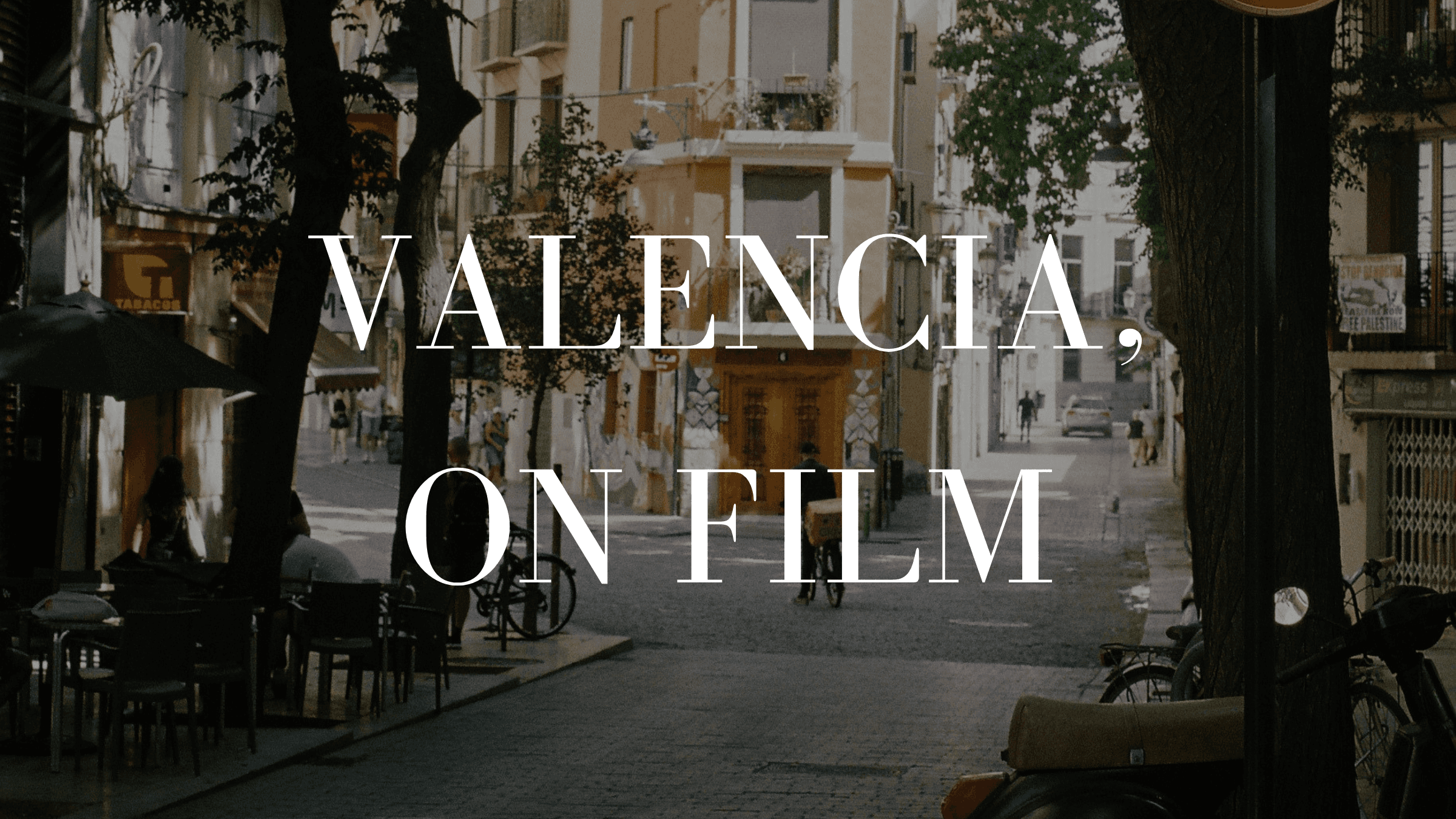
A while ago, I had an idea for a new photography series.
Over the years, I’ve been given a few film cameras that have been passed down to me by family and friends. They’ve sat around for quite a while, and if I’m completely honest, I’ve always been a little scared to actually use them.
I’d only ever really used a disposable film camera before. There’s something quite comforting about a disposable camera because it’s simple, point, shoot, wind it on, and hope for the best. These cameras were a little different. They actually required me to learn something.
So I thought: why not make that the challenge?
I wanted to start using the film cameras I’d been given and, over time, experiment with each of them. There’s no real end goal for the series, and I don’t want to rush it. I’d like to take them out with me and see where they fit into my photography, whether that’s landscapes, travel, fashion, portraits, architecture, or simply documenting something interesting that I come across.
I want to properly learn how to use them, rather than just point and shoot. I want to learn how to load and unload the film, understand the different settings, and eventually, hopefully, learn how to develop my own film in a darkroom too.
It felt like a good way to challenge myself and, honestly, remind myself how expressive film photography can be.
Starting with Valencia
The perfect opportunity came when I decided to take my first ever solo trip to Valencia this summer.
I knew I wanted to take a camera with me, and after a bit of thought, I decided this was the perfect excuse to finally start the series.
I packed my Olympus OM10, along with a roll of Kodak Gold 200, and took it with me.
The OM10 isn't a disposable or a simple point-and-shoot camera. I quickly realised that I actually needed to know what I was doing.
After around six years of mainly using a DSLR, I’ve become very used to being able to make an educated guess with my settings, take the photograph and immediately check the screen. If something is wrong, I can change it and take another.
Film doesn't let you do that.
There was no screen.
No checking my exposure.
No zooming in to see if I'd nailed the focus.
I had to trust myself.
I had to learn how to work with the aperture almost blindly and accept that I wouldn’t know whether I'd got it right until I had finished the entire roll and had it developed.
And there were only 36 photographs.
That definitely made me think a little differently.
Exploring Valencia
Luckily, Valencia was a pretty perfect place to start.
It was sunny for most of my trip, meaning I could keep things relatively simple with my settings. The more challenging part was when I wandered into the shaded back streets, where I had to think a little more carefully about what I was doing.
One thing I realised very quickly was just how much I love photographing architecture.
Whenever I go somewhere new, I’m always looking up, looking around and noticing buildings, shapes, colours and little details. It’s actually quite different from the majority of the work I’ve created professionally, which tends to centre around fashion, portraits and people.
For the first few days of my trip, I mostly just explored.
I tried new food, wandered around the city, went to the beach and generally enjoyed being somewhere completely new on my own. But while I was exploring, I was also keeping mental notes of places I wanted to come back to with my camera.
Because I only had 36 exposures, I couldn't just photograph everything.
I had to choose.
I actually found myself taking a quick photo on my phone first in some places, just so I could see how I might want to frame it before using one of my precious film exposures.
Eventually, I used the entire roll wandering around Valencia, through the backstreets, around the cathedral and through the City of Arts and Sciences.
And then came the part I'd been both looking forward to and slightly dreading.
Getting the film developed.
The moment of truth
After getting back home, I sent the roll off to be developed.
I decided to get both digital scans and physical prints, because I wanted to experience the photographs properly rather than just having them sitting on my computer.
And honestly?
I was so happy with them.
There’s something about seeing photographs you've taken on film that feels completely different.
I loved the colours. I loved the slightly soft, dreamy quality they had. They reminded me of looking through old family holiday photographs when I was younger, photographs that weren't necessarily technically perfect, but somehow felt full of a memory.
They aren't as crystal clear as the photographs I can produce on my DSLR. The focus isn't always as crisp, and there are little imperfections that I simply wouldn't get from shooting digitally.
But I don't think that's a bad thing.
Actually, I think that's part of what I love about them.
They feel different.
And that's exactly what I wanted from this series.
A different way of photographing
Something else I really enjoyed was how small and lightweight the OM10 was compared to my usual Canon 6D Mark II with a 24–105mm lens.
For travelling, it was brilliant.
It was light, easy to carry around and, let's be honest, pretty cute too.
But what I loved most was looking through the viewfinder again.
I haven't had to properly rely on a viewfinder in that way for a long time. It took me back to when I was first learning photography — when I had to physically look through the camera, focus the lens myself and really think about what I was photographing rather than relying on autofocus and the instant feedback of a digital screen.
It made photography feel a little slower.
A little more intentional.
And I really enjoyed that.
So, what's next?
This is hopefully just the beginning of the series.
I have more film cameras that have been passed down to me, and I’m really excited to eventually take each of them out and see what they can do.
I don't want this to become something I feel pressured to constantly produce, though. Film isn't exactly the cheapest hobby, especially when you're paying for film, development, scans and prints every time!
So this will probably be a once-in-a-blue-moon kind of project.
And I actually think that's okay.
I like the idea of having these little chapters spread out over time. One camera, one roll, one place or one idea at a time.
Maybe the next camera will come with me on another trip.
Maybe I'll take one out for a fashion shoot.
Maybe I'll photograph the South West.
Maybe I'll just walk around somewhere with it and see what happens.
Eventually, I'd also love to learn how to develop the film myself and spend some time in a darkroom. That's definitely something I want to work towards as I continue learning.
For now, though, I'm just really happy that I finally stopped being scared of using these cameras and actually gave it a go.
And I love that I now have a little collection of photographs from my first ever solo trip to Valencia that I couldn't have created in quite the same way digitally.
So, here we go.
The first camera in the series: the Olympus OM10.
I wonder which one will be next.